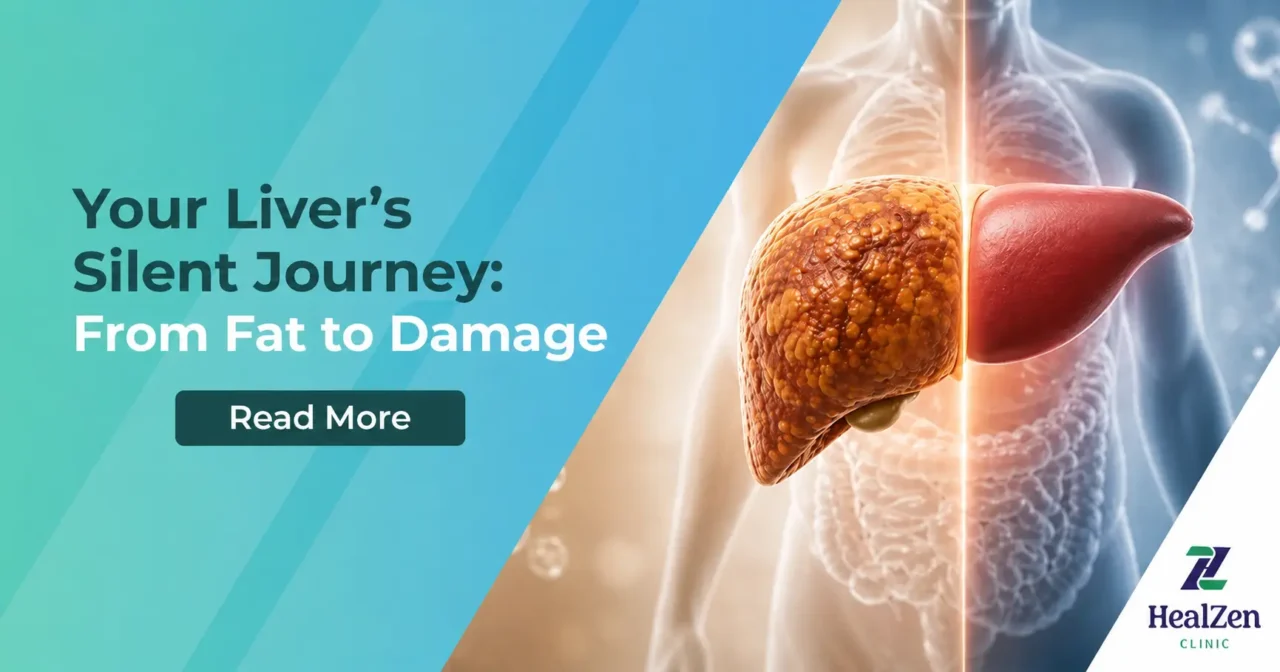
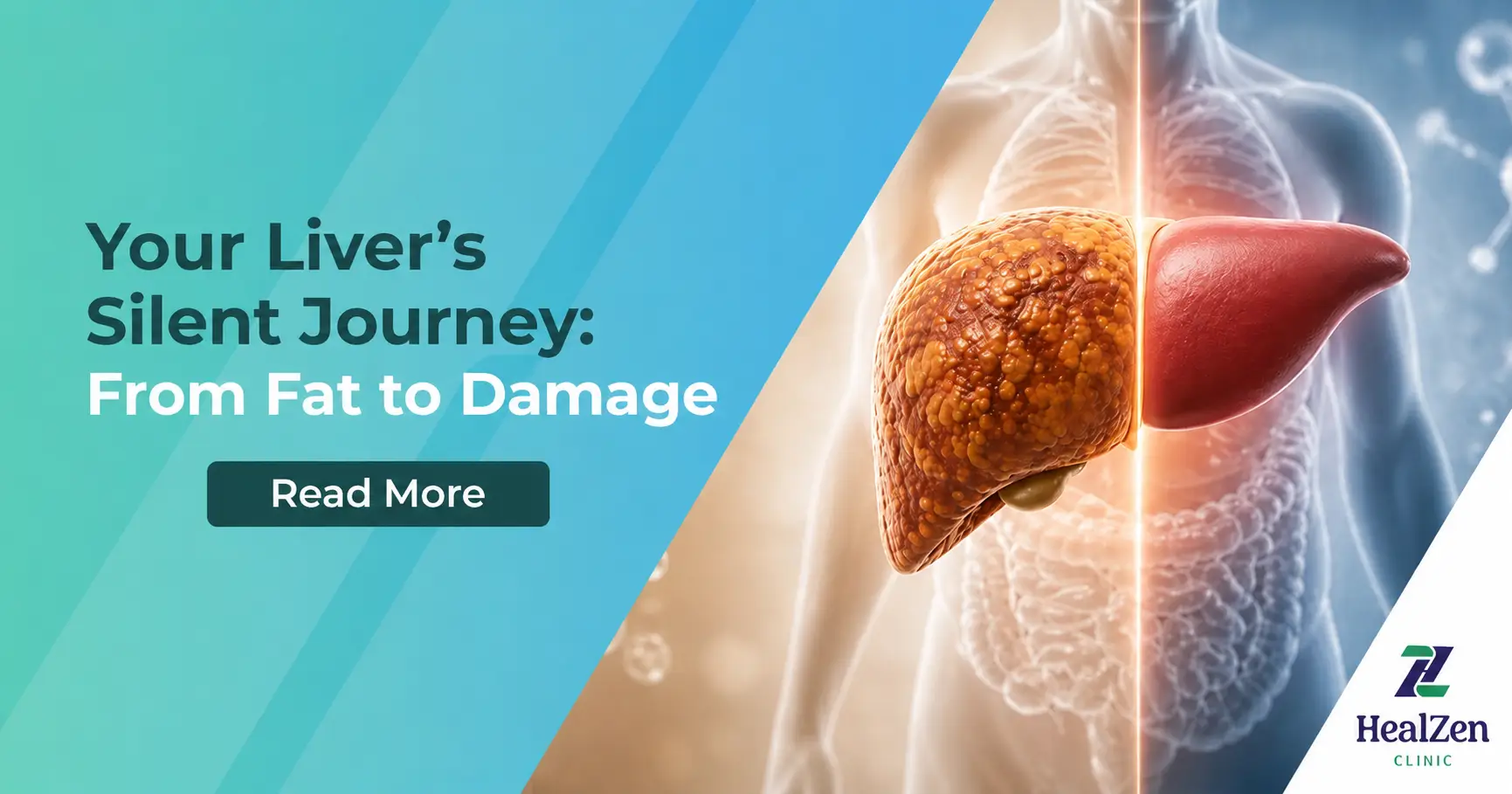
Every day, your liver works hard to detoxify your blood, process nutrients, and help with digestion. It also forgives easily, putting up with years of stress without complaining.
But fatty liver disease doesn’t happen all at once. What starts as a quiet buildup of fat can slowly become something worse. The first step to protecting your liver and your health is to understand how this happens.
Disease Progression at a Glance
Stage 1: Simple Fatty Liver (Steatosis)
At this very early stage, fat starts to build up in liver cells (hepatocytes). There is no major swelling, and the liver is still working normally. Most people don’t have any symptoms at all; it’s usually found by accident during an ultrasound done for another reason.
About 25% of the world’s population has this stage, and it is strongly linked to obesity, type 2 diabetes, high triglycerides, and metabolic syndrome. The good news is that it can be completely reversed by making changes to your lifestyle.
- Symptoms: None in most cases
- Diagnosis: Often found incidentally via ultrasound or blood tests
- Outlook: Fully reversible with diet and exercise
Stage 2: Non-Alcoholic Steatohepatitis (NASH)
NASH is when the story changes. The liver is now not just fatty; it is actively inflamed. Immune cells invade the liver tissue in response to oxidative stress caused by the fat deposits.
Liver cells begin to swell and die, and enzymes like ALT and AST become elevated in blood tests.
Around 20–30% of people with simple steatosis progress to NASH. Symptoms may now emerge: persistent fatigue, a dull ache in the upper right abdomen, and unexplained weight loss.
Importantly, NASH can still be reversed with sustained lifestyle intervention and, in some cases, medical therapy.
- Symptoms: Fatigue, upper right abdominal discomfort
- Key Marker: Elevated liver enzymes (ALT, AST) on blood tests
- Risk: 20–30% of NASH patients advance to fibrosis
The 10% Rule
Research consistently shows that losing just 7 to 10% of body weight can dramatically reduce liver fat, resolve inflammation, and even reverse early fibrosis.
You don’t need to reach an ideal weight; a modest, sustained loss makes a meaningful difference.
Stage 3: Liver Fibrosis
Prolonged inflammation triggers the liver’s wound-healing response: scar tissue (collagen fibres) begins to replace healthy liver cells. This is fibrosis.
The liver becomes stiffer, less flexible, and less efficient. Blood flow through the liver can become partially obstructed.
Fibrosis is graded F0–F4. Early fibrosis (F1–F2) may still partially reverse with treatment. Advanced fibrosis (F3) significantly raises the risk of progressing to cirrhosis.
Diagnosis typically requires a liver biopsy or a non-invasive test like FibroScan.
Symptoms intensify: fatigue, bloating, spider veins on the skin, and itching.
- Grading: F0 (no fibrosis) to F4 (cirrhosis)
- Reversibility: Partial reversal possible at F1–F2 only
- Diagnosis: FibroScan, liver biopsy, or blood-based markers
Stage 4: Cirrhosis
Cirrhosis represents the point of no return. Extensive scarring has replaced so much liver tissue that the organ can no longer perform its essential functions: detoxifying the blood, producing clotting proteins, or metabolising nutrients.
Symptoms are now severe and unmistakable, including jaundice (yellowing of the skin and eyes), ascites (fluid build-up in the abdomen), confusion from hepatic encephalopathy, and easy bruising or bleeding.
The risk of liver cancer (hepatocellular carcinoma) rises sharply.
In end-stage cases, a liver transplant becomes the only curative option.
- Symptoms: Jaundice, ascites, confusion, easy bleeding
- Complication: Elevated risk of hepatocellular carcinoma
- Treatment: Complication management; transplant in severe cases
The Window of Opportunity
Fatty liver disease is a slow-moving condition, which is both its danger and its greatest opportunity.
Stages one and two can be completely reversed with diet, exercise, weight management, and control of underlying conditions like diabetes and high cholesterol.
The liver is remarkably regenerative when given the chance.
If you have risk factors such as obesity, type 2 diabetes, metabolic syndrome, or high triglycerides, ask your doctor about a routine liver ultrasound.
Early detection, before inflammation and scarring take hold, is the most powerful tool available.